


Aug
14
Simply Suricates
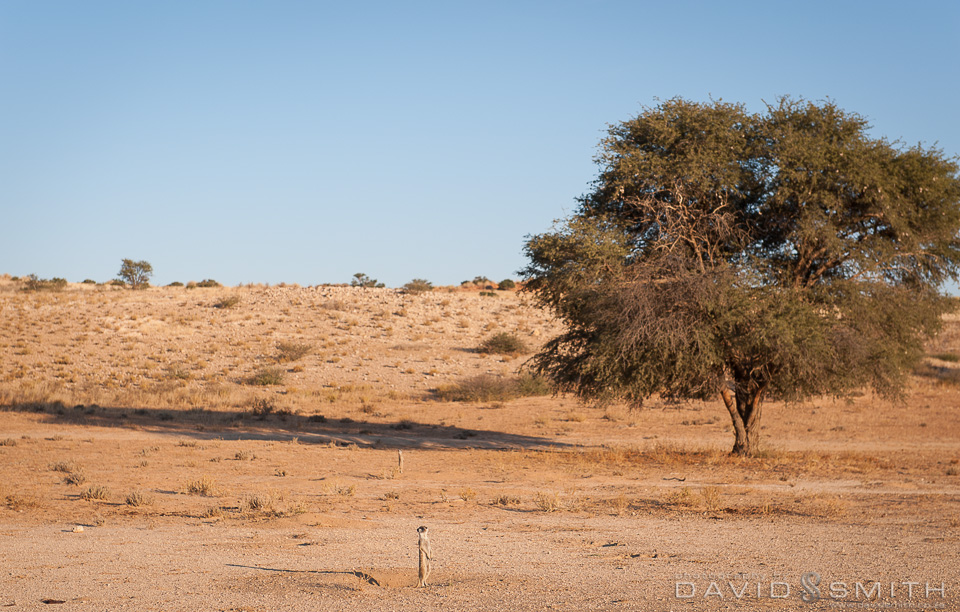
Suricates are one of those quintessentially necessary animals to see when you visit the Kalahari – in fact, we often used to say “You haven’t been in the Kalahari until you’ve seen Suricates”! On some trips however, they do seem to be a little scarce, so, on my recent trip to the Kgalagadi Transfrontier Park, I was delighted to be able to spend a good amount of time with several groups of these busy little creatures!
Having been made famous in the Animal Planet program “Meerkat Manor”, most people have a pretty good idea of the antics of these charismatic little creatures, but it is not until you spend some time with them in the wild that you get an idea of what they are really like. Firstly, I am always surprised at how small they actually are – so when looking for them in the open, you need to re-adjust your horizon. Adults weigh in on average at just around 0.7 kg, with a body length of just 30 cm, but it is their long tails of about 25 cm which allow them to stand and balance on their back legs in characteristic pose, and this is often how they will be seen. Very often the lookout will climb onto an anthill, or into the top branches of a bush to enable it to see danger from afar when there is cover that a predator may use to get close to the family while they are foraging.

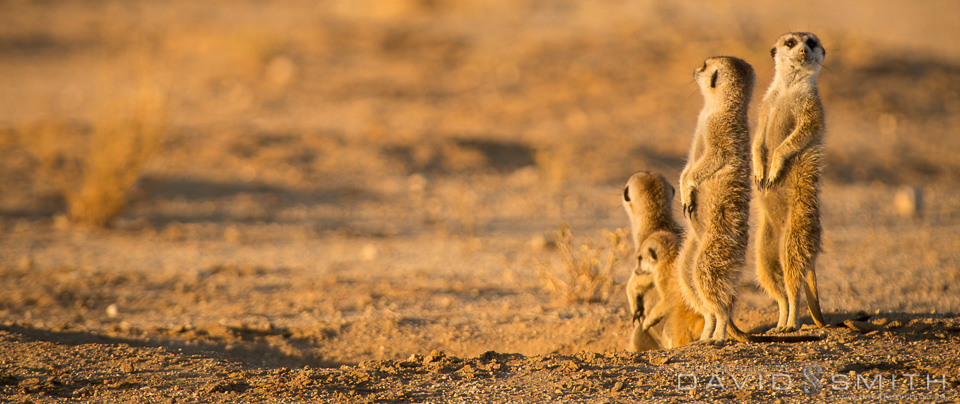
As the first rays of sunlight hit the earth and start warming the soil, you will often find the group huddled together right at the entrance to their burrow, with their hair stuck out like bottlebrushes – this helps them to retain their body heat by trapping an air layer close to their bodies. They also huddle close to share their collective warmth, with babies pressing in tight against the adults. As they warm up, the individuals will move off and start seeking out food. Sitting quietly you can hear the continuous chirps between the individuals as they keep in contact while they are searching for food – and there is always at least one who stays behind looking out for danger, and keeping a watch on the burrow entrance if there are youngsters inside.

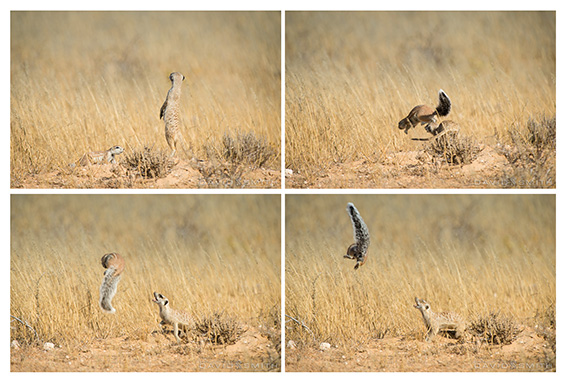
The predators they are watching for include eagles, jackals and snakes and if any are spotted a shrill cry sends the youngsters scurrying for the nearest hole, while all the adults cluster around the lookout, all staring intently at the danger and chirping. The biggest danger comes from the air, from eagles and other raptors. Should a large snake appear however, they will quite often mob it and chase it away from their burrow. Smaller snakes will become the prey – suricates are very happy omnivores, and their diet includes insects, scorpions, lizards, birds, fruit, small snakes, grubs and worms.

When you watch them scurrying about from bush to bush, digging away to get to the tasty morsels that they just seem to know are there, you can appreciate their high food requirements to fuel that boundless energy.

And as you see them digging deeper and deeper, burrowing their whole upper bodies and heads in the sand as they seek out their prey, you appreciate how vulnerable they would be without their lookout and the constant chirping communication which lets them know all is OK as they focus on finding food!

Some interesting facts about Suricates:
- Gregarious animals often seen in groups, and communities may exist of several families
- Groups are dominated by an alpha female and an alpha male – the alpha female is the only female allowed to have pups in the community … but the alpha male does pursue other (beta) females and if they have pups, they may be killed by the dominant female if she is pregnant.
- Females give birth to 2-4 each year after a gestation period of 77 days. Meerkat pups are hairless at birth, and eyes remain closed for at least 10 days. They only emerge from the burrow after about 3 weeks.
- Subordinate (beta) females take turns looking after the pups in the burrow until they are old enough to go outside.
- Suricates rely more on mentoring than instinct when learning to forage and watch for danger! So, elder suricates and siblings help to raise the young – teaching them how to watch for danger, how to forage…including how to eat scorpions without getting stung!
- Youngsters are only able to handle their own prey at about 3 months, and so rely on their baby-sitters to feed them.
- Adults and pups practise play fighting, to learn and practise skills, which help them to prepare for staking their claim in the group when they become adults.
- Beta males and beta females over ten months will normally leave the group before they are 3 years old. Beta males will leave voluntarily to find other groups where they may become dominant, and beta females are often evicted from the group by the alpha female when she gets pregnant – especially if they are pregnant too! Some may return to the group after the alpha female has given birth to her pups.
- Suricates utilise numerous burrows and may not return to the same one at the end of a day’s foraging, enabling them to extend their feeding range. The burrows have long tunnels and rooms, and remain at a fairly constant temperature in the heat of a summer’s day, or the cold of a winter’s night
- Sometimes burrows may be shared with ground squirrels and yellow mongooses.
At the end of a long day foraging, the suricate group will often be seen soaking up the last rays of sun while they groom each other with their mouths and long claws, some youngsters falling asleep on their feet as they get ready to head down into their burrow and sleep through the night, so they can be ready for another day of doing suricate things all over again the next day!
